Cloud Governance is no longer optional; it is essential. Without it, even well-resourced organisations risk spiralling costs, security gaps, and compliance breaches that can lead to crippling fines or downtime. With it, they gain predictable spending, airtight compliance, and the confidence to scale securely.
We have seen this contrast firsthand. Enterprises with mature governance frameworks maintain clear policies, automated guardrails, and real-time visibility across hybrid and multi-cloud environments. Those without often face uncontrolled sprawl, inconsistent security enforcement, and escalating costs.
At Matrix Solutions, decades of supporting regulated industries have shown us that cloud governance is not just a compliance checkbox; it is enterprise-critical infrastructure, turning cloud from a liability into a strategic platform for secure, compliant, and cost-efficient growth.
What Is Cloud Governance?
Cloud Governance is the framework that directs cost, security, compliance, and performance across hybrid cloud and multi-cloud environments. Beyond rules, it ensures resources are allocated, monitored, and controlled to align cloud operations with business goals, forming the foundation for the policies, risk controls, and assurance practices that follow.
Scope and Desired Outcomes
The Cloud Governance scope covers key functions that align cloud operations with business goals across hybrid and multi-cloud environments:
- Cost control: Enables accurate budgeting and prevents overspending
- Security assurance: Minimises breach risks through enforced controls
- Compliance adherence: Ensures regulatory alignment and audit readiness
- Operational efficiency: Streamlines processes and reduces resource waste
- Accountability: Clarifies ownership of resources and policies
These outcomes position cloud governance as a core driver of secure, efficient enterprise IT.
Core Functions Across Policy, Risk, and Assurance
Within the Cloud Governance framework, three core functions underpin any governance policy cloud model: establishing rules, managing risks, and verifying compliance across hybrid cloud and multi-cloud environments.
| Function | Purpose | Responsible Role |
|---|---|---|
| Policy Creation | Establishes rules for security, cost, and operational standards | Cloud governance lead / IT operations |
| Risk Management | Identifies and mitigates security, compliance, and performance risks | Security team / Compliance officer |
| Assurance Monitoring | Audits configurations and validates adherence to policies | Internal audit / DevSecOps team |
Principles and Guardrails for Effective Cloud Governance
Strong Cloud Governance relies on core principles that guide every decision, policy, and process. These cloud governance principles act as a strategic compass, driving maturity and resilience, especially in highly regulated environments.
Accountability: Clear ownership ensures tasks are done and audited
Transparency: Visible policies reduce shadow IT and hidden spend
Consistency: Uniform processes prevent drift and misconfigurations
Adaptability: Governance evolves alongside cloud innovation
Automation: Machine-enforced policies reduce human error and overhead
These principles form the foundation for reliable, compliant, and efficient cloud operations.
Key Components of a Cloud Governance Framework
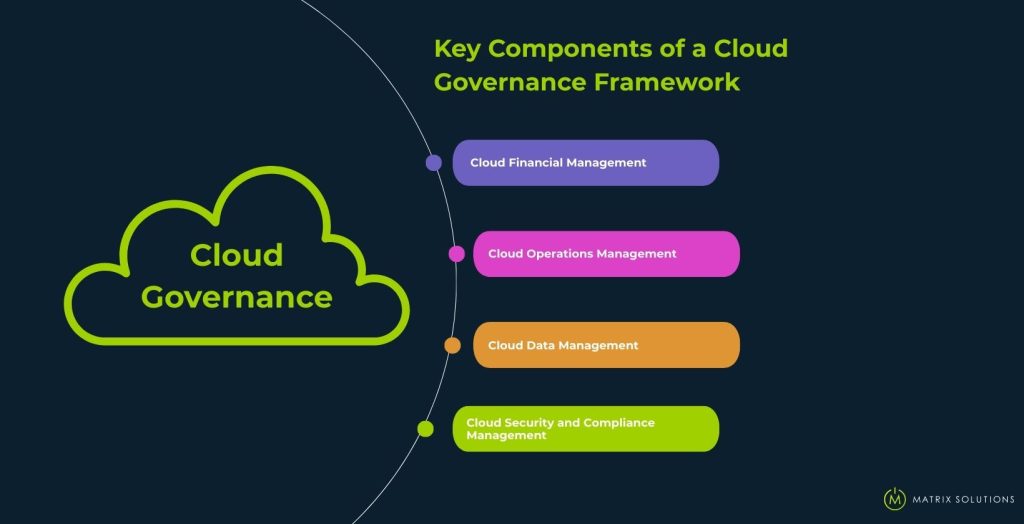
A practical cloud governance framework is built on a small number of components that translate policy into day-to-day control. These components connect strategy to operations and ensure security, compliance, and cost outcomes are repeatable across environments.
1. Cloud Compliance and Risk Management: Ensures alignment with regulatory requirements and manages security, compliance, and operational risks.
2. Cloud Data Management: Classifies, protects, and manages data residency, retention, and lifecycle obligations.
3. Cloud Financial Management: Controls cloud spending through budgets, tagging, rightsizing, and cost visibility.
4. Cloud Operations Management: Standardises deployment, monitoring, incident response, and IaC practices for consistent operations.
Why Cloud Governance Matters for Enterprise Cloud Strategy
The importance of Cloud Governance lies in aligning cloud operations with business goals. It streamlines hybrid and multi-cloud environments, boosting efficiency and enabling controlled, conflict-free resource deployment.
- Run a cost governance audit → identify top 10 runaway resources.
- Assign a Governance Owner (CISO, CIO, or Cloud Lead) within 30 days.
- Create a Governance Starter Pack: 5 policies (IAM, tagging, logging, cost alerts, encryption).
- Schedule a quarterly review where compliance + FinOps + security teams align.
This turns the section from conceptual to immediately actionable.
Core Pillars to Get Cloud Governance Right
Effective Cloud Governance relies on four operational pillars that drive control, security, and cost discipline within cloud data governance:
- Multi-Cloud Policies: Standardise provisioning, access, and usage rules to prevent drift and shadow IT
- Security and Compliance Controls: Embed IAM, encryption, and logging to meet regulatory requirements
- Financial Governance: Track usage, set budget alerts, and forecast costs to curb overspending
- Data Residency and Lifecycle: Classify data, enforce Australian residency, and automate retention policies
Proven Cloud Governance Frameworks and Standards Used in Australia
Implementing a solid Cloud Governance framework bridges strategy and execution. These frameworks provide repeatable structures that reduce ambiguity, align cross-functional teams, and embed governance into daily operations. Mapping them to existing enterprise policies ensures consistency, regulatory compliance, and scalable cloud operations.
Cloud Security Alliance (CSA) Cloud Controls Matrix (CCM v4.0)
The CSA Cloud Controls Matrix (CCM v4.0) is a leading standard for aligning Cloud Governance with security, privacy, and compliance, offering 17 control domains to manage multi-cloud risk through structured policies and audits.
| Control Domain | Primary Governance Objective |
|---|---|
| Identity & Access Management | Enforce least privilege and secure user access |
| Infrastructure & Virtualisation Security | Standardise system hardening and network protection |
| Compliance | Maintain alignment with legal and industry regulations |
| Risk Management | Identify, track, and mitigate operational risks |
| Business Continuity Management | Ensure resilience and recovery during disruptions |
| Data Security & Privacy | Protect sensitive data with encryption and retention policies |
| Logging & Monitoring | Enable continuous oversight and incident detection |
These domains give enterprises a clear structure to embed security and compliance controls into their cloud governance strategies.
CSA STAR Registry for Continuous Compliance
The CSA STAR Registry strengthens Cloud Governance by rating providers on security and compliance maturity. This cloud STAR registry builds trust and enables enterprises to verify controls, with STAR checkpoints integrated into CI/CD pipelines to block non-compliant deployments (e.g., in AWS CodePipeline).
ISO 27001, APRA CPS 234, IRAP, AND ISM for Regulated Industries
In regulated sectors, cloud governance relies on established frameworks that drive security, resilience, and accountability, making them essential to regulated industry cloud governance for securing data, facilitating audits, and responding to incidents.
| Framework | Purpose | Key Governance Obligations | Sector Relevance |
|---|---|---|---|
| ISO 27001 | Global information security management | Security controls, risk assessments, and continuous improvement | All industries |
| APRA CPS 234 | Protect data in financial institutions | Breach reporting, security testing, and formal risk management | Banking, insurance, superannuation |
| IRAP | Assess cloud systems for government use | Sovereign cloud hosting, vetted service providers | Federal and state agencies |
| ISM | Secure handling of government-classified data | Access control, incident response, security monitoring | Defence, government departments |
- APRA CPS 234: Requires sensitive financial data to be stored within the Australian jurisdiction
- IRAP: Mandates sovereign cloud environments for hosting government workloads
Shared Responsibility in the Cloud

The Shared Responsibility Model defines how security and compliance are split between providers and customers. This shared responsibility model cloud approach clarifies risk ownership, providers secure infrastructure, while customers protect data, configurations, and access to meet SLA and compliance requirements.
Amazon Web Services, Microsoft Azure, and Google Cloud Allocation Basics
Each provider uses distinct tools to manage AWS, Azure, and GCP responsibility within the Shared Responsibility Model under broader Cloud Governance:
- AWS Organisations: Centralises accounts, enforces Service Control Policies, and isolates environments
- Microsoft Azure Policy: Defines policies, tracks compliance, and auto-remediates non-compliance
- Google Cloud Organisation Policy Service: Sets resource constraints, enforces security baselines, and ensures consistent configurations
Mapping Internal Accountabilities and Closing Common Gaps
Unclear ownership often drives governance failures, making internal accountability governance vital to effective Cloud Governance. RACI matrices map who owns, approves, supports, and executes tasks like patching, audits, and cost tracking. One firm cut audit failures after missed patches by assigning clear owners through RACI. With guidance from Matrix Solutions, such mapping can pair with continuous monitoring and compliance reporting to reduce audit fatigue and cost leakage.
Policy Design for Multi-Cloud and Hybrid Cloud
Effective Cloud Governance depends on consistent policies across all environments. Strategic policy standardisation multi-cloud reduces compliance gaps, prevents cost leakage, and simplifies management by aligning identity, tagging, and data residency rules, creating a unified governance layer for hybrid and multi-cloud operations.
Access Control, Identity, and Least Privilege
Effective Cloud Governance depends on enforcing least privilege through role-based IAM and multi-factor authentication. This cloud access control governance approach limits user permissions to only what is required, reducing the risk of breaches and misconfigurations.
- Removing contractor admin rights prevented resource deletion
- Enforcing MFA blocked unauthorised logins
- Role segmentation that stopped cross-environment access
Tagging and Naming for Cost, Ownership, and Reporting
Consistent tagging is essential for Cloud Governance, enabling accurate cost allocation, clear ownership, and reliable reporting. Applying cloud resource tagging best practices brings visibility across multi-cloud environments.
- Include mandatory fields: cost centre, environment, owner, project, and region.
- Use standardised naming conventions (lowercase, hyphen-separated)
- Apply tags at resource creation to avoid gaps.
- Automate tag enforcement with policy-as-code
- Regularly audit tags to maintain accuracy and completeness.
Data Classification and Residency Requirements in Australia
Proper data classification is vital to Cloud Governance, ensuring compliance with the Privacy Act and APRA CPS 234. Aligning classification levels with cloud data residency Australia rules helps protect sensitive information and meet regulatory obligations.
| Classification Level | Residency Obligation |
|---|---|
| Public | Can be stored in any geographic region |
| Internal | Must be stored within Australian jurisdiction |
| Confidential | Must be encrypted and hosted in AU-certified facilities |
Cost Governance and FinOps in AUD
Strong Cloud Governance depends on disciplined cloud cost governance, using FinOps practices to forecast usage, prevent overprovisioning, and align spending with business goals in Australian dollars. Tracking the right KPIs ensures costs remain transparent and controlled.
- Cost per workload: Measures the efficiency of each deployed service
- Budget variance: Flags overspending against forecasted budgets
- Reserved instance coverage: Tracks cost optimisation from long-term commitments
These metrics help enterprises maintain financial control while scaling cloud operations predictably.
Automation and Tooling for Governance
Cloud Governance now relies on automated compliance cloud tools, policy-as-code, IaC, and compliance automation to enforce policies consistently, cut human error, and speed secure deployments.
Policy-as-Code and Continuous Compliance
Policy-as-Code embeds compliance directly into CI/CD pipelines by defining governance rules as code. This policy, as a code cloud approach, automates policy checks during builds, blocking non-compliant resources before deployment.
For example, a build pipeline using Terraform with Open Policy Agent can fail deployments that lack mandatory encryption or tagging policies.
Infrastructure as Code Workflows With Terraform or Pulumi
Infrastructure as code (IaC) tools like Terraform and Pulumi support Cloud Governance by embedding tagging, security, and compliance policies directly into provisioning templates. This Terraform governance approach enforces standards automatically as resources are deployed.
- Apply mandatory cost centre and owner tags within resource templates
- Define security group rules to block open inbound ports
- Enforce encryption settings on storage resources by default
Building an Effective Cloud Governance Operating Model
A Cloud Governance Operating Model acts as a playbook uniting people, processes, and tools to deliver predictable outcomes across departments. Adapting global standards like COBIT, ITIL, and ISO 27001 into a company-specific model ensures governance practices are consistent, measurable, and scalable.
Design a RACI Matrix for Clear Roles
A RACI matrix clarifies Cloud Governance Roles, defining who is Responsible (does), Accountable (owns), Consulted (advises), and Informed (updated):
- Security: Responsible—DevSecOps; Accountable—CISO; Consulted—Cloud architect; Informed—Operations lead
- Compliance: Responsible—Compliance officer; Accountable—Risk manager; Consulted—Legal team; Informed—Executive board
- Cost: Responsible—FinOps analyst; Accountable—CFO; Consulted—Project managers; Informed—Department heads
- Operations: Responsible—Cloud engineer; Accountable—IT operations lead; Consulted—Support team; Informed—Service desk
Embed Governance into DevSecOps Workflows
Integrating Cloud Governance into DevSecOps embeds security and compliance checks within development, not after deployment. This devsecops governance integration uses CI/CD gates, automated compliance tests, and security scans to block non-compliant code early.
For example, one team reduced release rollbacks by 40% after adding policy checks and vulnerability scans into their build pipeline, ensuring only compliant, secure code reached production.
Track KPIs to Measure Governance Maturity
Improving Cloud Governance requires measurable cloud governance metrics that show progress in compliance, cost control, and risk management.
These KPIs link governance maturity to business outcomes across sectors:
- Compliance adherence rate: % of controls passed (critical for finance audits)
- Cost optimisation score: Savings from rightsizing and reserved instances (vital for healthcare budgets)
- Incident response time: Average time to resolve security events (key for regulated industries)
- Audit readiness index: Timeliness and accuracy of audit evidence (essential for government reporting)
Common Challenges in Scaling Cloud Governance
As organisations grow, Cloud Governance complexity surges, new environments, expanding teams, and diverse compliance obligations amplify risk. Balancing growth with control becomes one of the toughest cloud governance challenges, often straining existing policies and oversight mechanisms.
Managing Compliance Overlap and Audit Fatigue
Overlapping standards like ISO 27001, PCI DSS, and HIPAA often create duplicated effort and audit fatigue in scaling Cloud Governance. Addressing this compliance overlap cloud challenge requires streamlining audits through shared processes.
- Map common controls across frameworks to reduce duplication.
- Reuse audit evidence across multiple certifications
- Centralise documentation as a “compliance as a shared service” function
- Automate evidence collection to cut manual workload
Addressing Security Risks in Ephemeral Environments
Ephemeral workloads like containers and serverless functions heighten ephemeral cloud security risks in Cloud Governance. Mitigation requires runtime scans, short-lived credentials, and automated policy enforcement.
- Automated scans caught an open port in a container cluster pre-deployment
- Short-lived tokens prevented credential reuse in serverless workflows
- Policy-as-code blocked untagged ephemeral resources from launching
Reducing Vendor Lock-In Across Cloud Providers
Vendor lock-in can limit flexibility, raise costs, and slow innovation. Strong Cloud Governance helps in avoiding vendor lock-in in cloud environments by enabling portability through resource abstraction and contractual safeguards.
- Instance rightsizing: Keeps workloads portable and cost-efficient.
- Autoscaling policies: Maintain performance while reducing dependence on fixed vendor capacity
- Budget alerts: Flag rising spend early to support migration planning
- Cross-provider API use: Standardises integrations and reduces reliance on proprietary services
- Containerisation: Packages workloads for easier movement between providers
What Is Next in Cloud Governance: AI Assistance, Edge, and Sovereign Cloud
Future Cloud Governance is shifting toward automation, distributed infrastructure, and stricter compliance, core future trends that cloud governance leaders must anticipate. Advancements in AI-driven policy enforcement, edge computing, and sovereign cloud frameworks are redefining how organisations maintain control.
AI-Assisted Policy Enforcement and Threat Detection
AI is transforming Cloud Governance through predictive policy enforcement, anomaly detection, and automated remediation. This AI in cloud governance improves security while cutting response times and false positives.
- Deploy AWS GuardDuty, Azure Security Center, or Google Chronicle now for ML-driven anomaly detection.
- Train SecOps teams on triaging AI alerts vs human oversight.
- Create a playbook for auto-remediation scenarios (e.g., revoke credentials, block non-compliant deployments).
Governance for Edge and Distributed Cloud
Edge environments like IoT, 5G, and micro data centers add edge computing governance complexity to Cloud Governance, requiring low-latency compliance, local policies, and cross-region security alignment.
- Latency compliance: Real-time rules for autonomous vehicles
- Local policy enforcement: Jurisdiction-specific controls for telemedicine
- Cross-region security: Standardised encryption and access across edge nodes
Adapting to Evolving Global and Local Compliance Expectations
Emerging regulations are reshaping Cloud Governance. Staying ahead of emerging compliance standards and cloud requirements is critical as global frameworks introduce new security, privacy, and accountability obligations.
| Standard | Key Governance Requirements |
|---|---|
| EU Cybersecurity Act | Certification of cloud services, incident reporting, and security baselines |
| ISO/IEC 42001 (AI) | AI governance policies, risk assessments, and algorithm transparency |
| Digital Personal Data Protection Act (India) | Data localisation, consent tracking, breach notification |
These frameworks demand proactive updates to policies, controls, and reporting to maintain compliance in evolving cloud environments.
Cloud Governance vs Cloud Management vs Cloud Security

Confusion between these roles causes gaps in strategy. Cloud Governance sets policy and oversight, cloud management drives execution and operations, and cloud security delivers protective controls; a clear governance vs management vs security model prevents overlap.
Strategic Remit of Governance Beyond Operations
In Cloud Governance, governance defines direction while management executes. This governance vs management in cloud split ensures control beyond operations.
- Blocked non-compliant data deployment
- Enforced tagging to prevent cost issues
- Mandated security baselines before production
How Governance Complements Security Without Overlap
In Cloud Governance, governance sets security requirements while security teams implement them. This governance and security in the cloud approach ensures clear roles without duplication.
- Mandating encryption for all data at rest and in transit
- Requiring MFA and role-based IAM for privileged accounts
- Defining patching timelines and vulnerability remediation SLAs
Minimum Viable Cloud Governance Checklist
A clear Cloud Governance foundation reduces risk and complexity. This cloud governance checklist covers the essential elements every environment needs:
- Baseline security and operational policies
- Identity and access management (IAM) with least privilege
- Cost guardrails and budget alerts
- Compliance control mappings to regulatory standards
- Continuous monitoring and audit logging
- Regular policy reviews and updates
FAQs on Enterprise Cloud Governance
What Are the First Steps to Start a Cloud Governance Program?
To start Cloud Governance, define policies, assign roles, set compliance baselines, and implement monitoring tools. These steps build accountability, cost control, and security from day one (how to start cloud governance).
How Does Cloud Governance Support Zero Trust Security Models?
Cloud governance supports Zero Trust Security by enforcing strict access controls, continuous verification, and data segmentation. This reduces implicit trust, aligning with least-privilege principles (cloud governance zero trust).
What Is the Role of Automation in Continuous Cloud Compliance?
Automation in cloud governance embeds compliance checks into CI/CD pipelines, enabling real-time policy enforcement and reducing manual errors (automation in cloud compliance).
How Do Cloud Governance Policies Differ Across Public, Private, and Hybrid Clouds?
Cloud governance public vs private vs hybrid differs in control scope: public clouds need stricter vendor oversight, private clouds demand internal controls, and hybrid setups require unified policies bridging both.
What Metrics Best Show the ROI of Cloud Governance Initiatives?
Common cloud governance ROI metrics include cost savings, reduced incident response time, audit success rates, and policy compliance scores to link governance to business value.
How Can Organisations Keep Governance Aligned With Rapid Cloud Adoption?
To maintain scaling cloud governance, continuously update policies, automate controls, and review roles as teams and cloud usage grow.
Key Takeaways for Cloud Governance in Australia
- Strong Cloud Governance enables predictable costs, tighter security, and regulatory compliance.
- Clear policies and roles are core to multi-cloud governance best practices
- Automation reduces human error and speeds policy enforcement
- Continuous monitoring and KPI tracking drive governance maturity
- Framework alignment ensures consistency across hybrid and multi-cloud environments.
As cloud environments evolve, investing in governance maturity will safeguard agility, compliance, and long-term business resilience.
Secure, compliant, and governed cloud operations
Close governance gaps and enforce security-by-default across your cloud environments. Get Managed Cloud Security Services that deliver continuous protection.
Free Consultation!