The ASD Essential Eight Maturity Model defines how organisations prevent, limit, and recover from cyber incidents. The model standardises security expectations across Australian businesses by assigning measurable maturity levels to eight core mitigation strategies. These strategies form a defence baseline for internet-connected IT environments and support predictable, repeatable cyber resilience uplift.
Understanding the Essential 8 and Its Origins
The Australian Signals Directorate (ASD) created the Essential Eight to reduce the frequency and impact of cyber incidents across Australian networks. The framework forms part of ASD’s broader prioritised mitigation guidance and supports organisations that need clear, evidence-based controls for common intrusion methods. The Essential Eight applies primarily to internet-connected IT systems and is not designed for operational technology or enterprise mobility environments, where different mitigation strategies may be more appropriate.
The Essential Eight maturity model was first released in 2017 and continues to be updated as attacker behaviour, system complexity, and business requirements evolve. The model reflects ASD’s operational insights gained from threat intelligence analysis, incident response work, and penetration testing activities across Australian environments. The Essential Eight supports consistent security behaviour by defining a minimum baseline for preventing unauthorised access, limiting attacker movement, and maintaining data availability. Organisations use the model to understand their current posture and plan targeted security improvements.
What are the Objectives of the Essential Eight?
The Essential Eight is built around core cybersecurity mitigation strategy objectives that aim to prevent cyberattacks, minimise the impact of intrusions, and support reliable data recovery. These objectives form the foundation of practical cyber resilience for Australian organisations and are explained in detail below.
Prevent Cyberattacks
Preventing cyberattacks starts with closing the common gaps attackers exploit during cybersecurity incidents, such as malicious macros, outdated software, or unapproved applications. Tightening these weak points makes it far harder for an intruder to gain an initial foothold. In a typical SME or law firm, something as simple as blocking untrusted macros or keeping applications patched can stop a threat before it runs. Even with strong prevention, intrusions can still occur.
Reduce the Impact of Cyber Intrusions
Limiting the impact of cyber intrusions is about stopping attackers from moving deeper into a network once they’ve gained entry during cybersecurity incidents. When privileges are limited and activity is monitored, an intruder has far fewer opportunities to escalate access or move laterally. For example, if a compromised user account lacks admin rights, the attacker is contained before they can reach sensitive systems or data.
Maintain Data Recovery and System Availability
Maintaining data recovery and system availability ensures a business can keep operating even after an incident, which is essential as business against cyber threats becomes more complex. Reliable backups, including immutable copies, allow critical data to be restored quickly, while regular recovery testing confirms systems can return online without major disruption. This level of continuity is especially important for SMEs that depend on consistent access to files, email, and case-management tools.
How Do You Implement the Essential Eight
- Select a target maturity level based on risk and business requirements.
- Progress sequentially from lower to higher maturity to avoid unmitigated gaps.
- Apply the same maturity level across all eight controls to prevent weakest-link exposure.
- Minimise and document exceptions so gaps remain visible and controlled.
- Use compensating controls where required and review them regularly.
- Verify enforcement by monitoring system activity, patching cadence, and access behaviour.
Essential Eight Maturity Levels
Maturity Level Zero
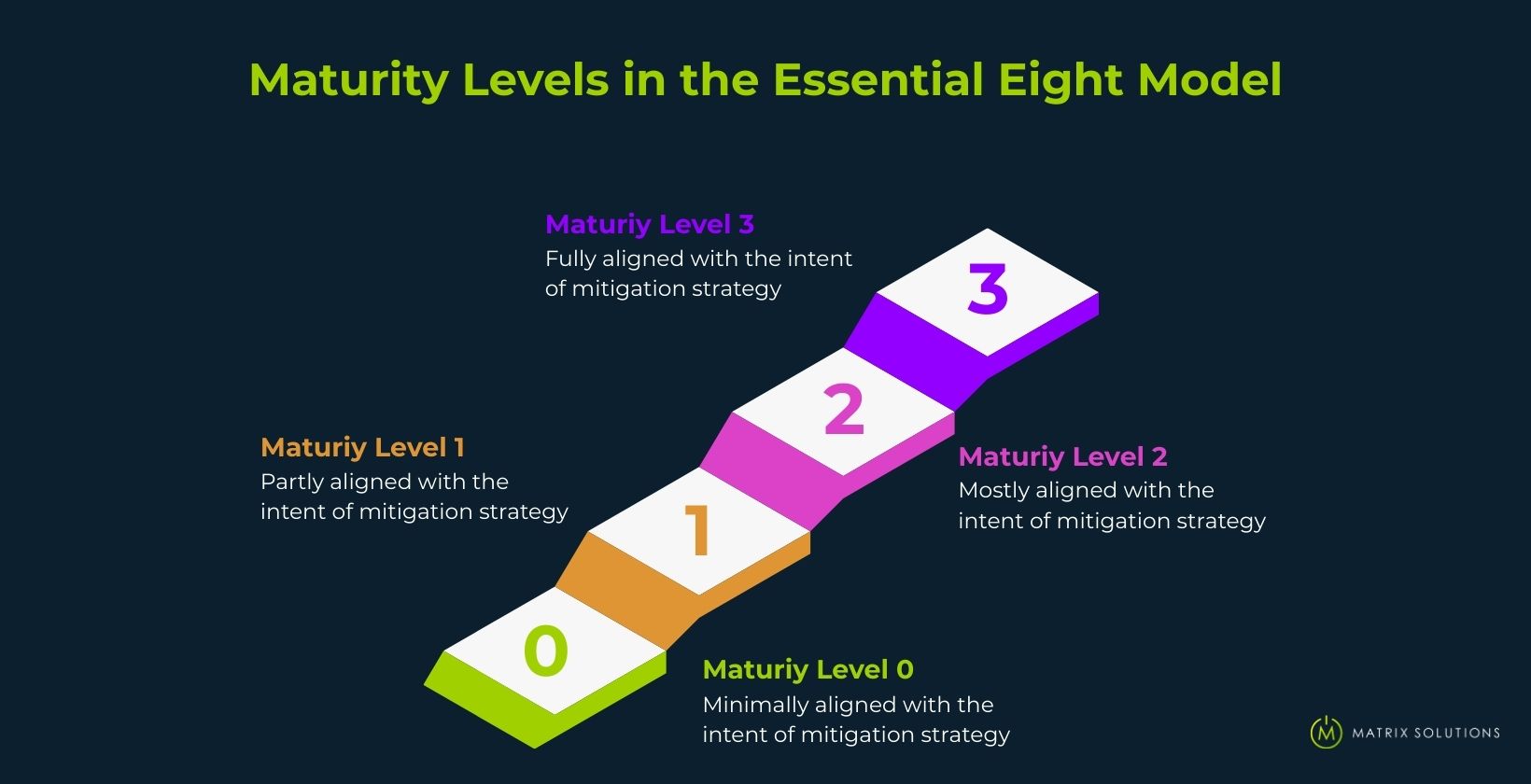
Maturity Level Zero signals weak control alignment. Attackers can exploit basic gaps and compromise systems with minimal effort. These weaknesses enable the tradecraft seen at Level One, increasing the risk of loss of confidentiality, integrity, or availability across affected systems.
Maturity Level One
Maturity Level One counters commodity threats. Attackers use public exploits, weak or reused credentials, and simple social engineering. They target any accessible victim rather than specific organisations. If attackers gain privileged access, they exploit it immediately and may delete data, including backups, to maximise damage.
Maturity Level Two
Maturity Level Two addresses adversaries with improved tools and patience. They refine tradecraft to bypass weak controls, evade limited monitoring, and exploit incomplete MFA enforcement. These attackers use targeted phishing, test credential pathways, and attempt privilege escalation. If they obtain privileged access, they can destroy all data accessible to that account.
Maturity Level Three
Maturity Level Three mitigates adaptive threats. These adversaries exploit outdated software, misconfigurations, and insufficient logging. They move laterally, harvest credentials or authentication tokens, and maintain persistence while concealing activity. They may coerce users into bypassing controls and can delete all reachable data if the intent escalates.
Common Requirements Across All Maturity Levels
Across every maturity level, the Essential Eight relies on consistent governance practices that ensure each control is properly applied and meets business requirement standards.
Key foundations include:
- Documentation: Clear records of policies, procedures, and control configurations.
- Reporting: Regular reviews that show how each control is performing in practice.
- Monitoring: Ongoing visibility of system activity to confirm controls remain effective.
- Evidence of enforcement: Proof that security measures are applied consistently across users, systems, and environments.
Choosing a Target Maturity Level For Your Business
Your target level depends on attacker capability, targeting likelihood, and the consequences of losing confidentiality, integrity, or availability. Organisations must consider which tradecraft level they need to withstand, not which attacker type they expect. Even robust Level Three controls may not stop adversaries willing to invest significant time, money, and effort. Organisations may require additional mitigation strategies beyond the Essential Eight to manage advanced risks.
What are the Essential Eight Mitigation Strategies?
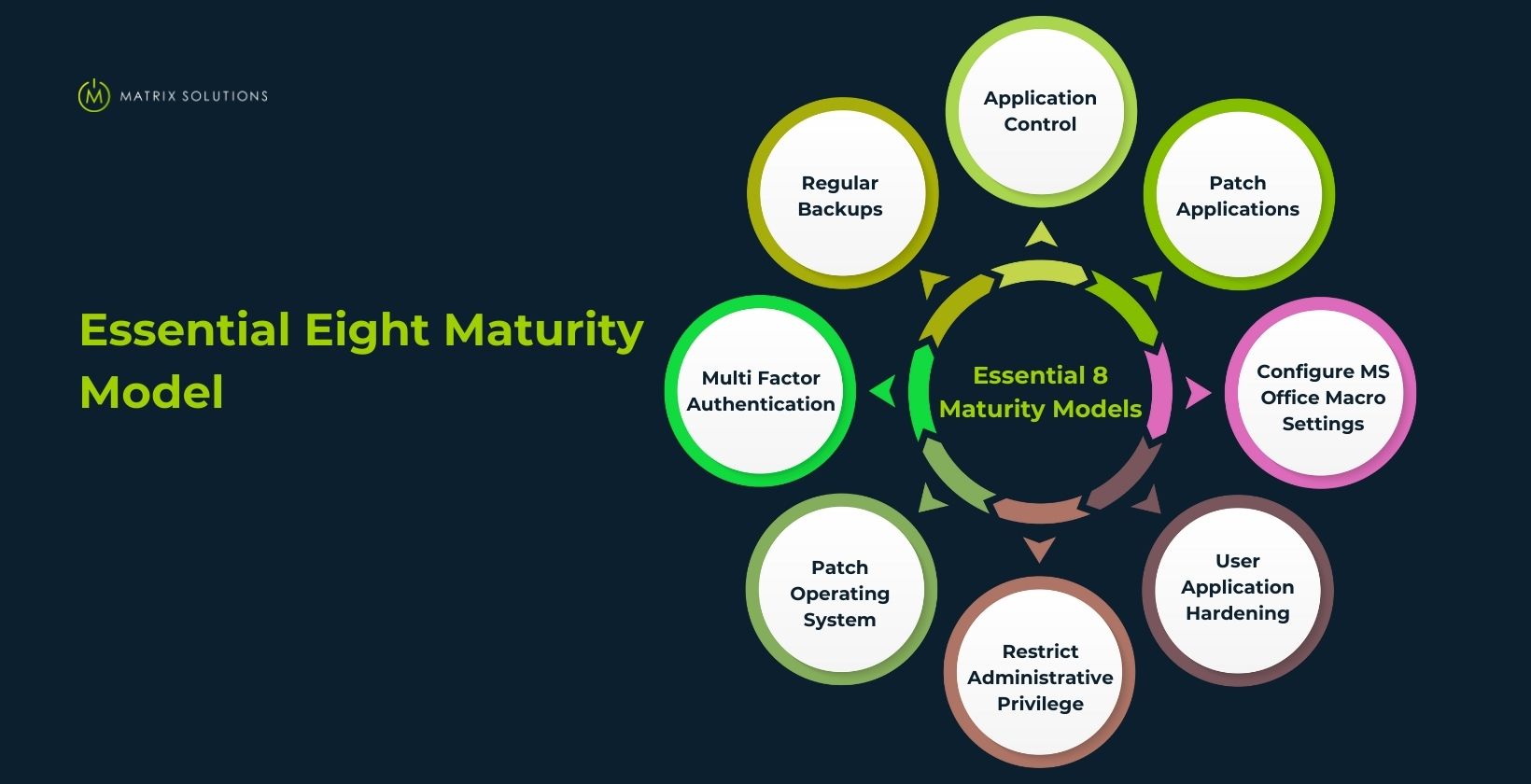
The Essential Eight mitigation strategies create layered protection against common intrusion methods. Each strategy restricts attacker activity, reduces exploit opportunities, and maintains system availability during security incidents.
1. Application Control
Application control ensures that only approved and trusted programs can run on systems. It blocks unverified tools, prevents malicious code from executing, and restricts software that could harm systems or network resources.
2. Patch Applications
Application patching closes vulnerabilities in browsers, Office tools, PDF readers, and mobile apps. Attackers often exploit flaws within days of disclosure, which makes prompt updates essential. Consistent patching supports maturity alignment and strengthens the baseline against common tradecraft.
3. Configure Macro Settings
Macros automate tasks through embedded code. Attackers use malicious macros in phishing documents to gain access or run harmful scripts. Blocking untrusted or unsigned macros removes a frequent initial access vector.
4. User Application Hardening
User application hardening disables risky features in browsers, PDF readers, and similar tools. It blocks unnecessary plugins, restricts legacy components, and removes unused applications such as Flash or Java. These adjustments limit common exploitation paths.
5. Restrict Privileged Access
Privilege restriction limits administrative access to users who genuinely need it. Controls review elevated access, prevent privileged accounts from using internet email or web services, and adjust permissions following staff changes. Cloud services require the same privilege governance to avoid broad compromise.
6. Patch Operating Systems
OS patching removes systemic weaknesses that attackers routinely target. Supported versions and timely updates maintain a secure baseline and reduce exposure to high-impact vulnerabilities.
7. Multi-Factor Authentication (MFA)
MFA adds verification beyond passwords and protects high-risk actions such as payments or billing changes. Updated requirements prioritise stronger factors, including something users have. Phishing-resistant MFA becomes essential at higher maturity levels.
8. Regular Backups
Regular, secured backups maintain data availability after corruption, deletion, or ransomware events. Organisations identify critical data, store protected copies, and validate restoration to ensure recovery works during real incidents.
What the Essential Eight Does Not Cover
The Essential Eight represents a minimum preventative baseline. It does not address all threat scenarios or advanced adversaries that invest significant time and resources. Some environments require additional controls from broader ASD guidance or industry-specific frameworks. Even at Maturity Level Three, organisations must consider supplementary measures to address residual risks.
The Essential Eight for Law Firms and Professional Services
Law firms and professional services operate with sensitive client data, confidential documents, and specialised case-management systems that require uninterrupted access and must remain defensible in an audit. These environments face elevated and specific risks, including legal privilege compromise, data breach notification obligations, and threats stemming from phishing, compromised credentials, and outdated applications.
Applying the Essential Eight provides robust security for law firms and professional services by addressing the critical areas where compliance and confidentiality risk intersect.
The Essential Eight measures:
- Strengthen identity controls through Multi-Factor Authentication (MFA), which protects access to sensitive data and cloud-based legal tools (e.g., NetDocuments, iManage).
- Reduce exposure to macro-based attacks and malware delivery vectors common in email.
- Improve device hardening and vulnerability management to protect against known exploits.
- Enforce least-privilege access, preventing an attacker who compromises one account from gaining elevated access to the entire network or trust accounting systems.
- Maintain data continuity and resilience through reliable, immutable backups, ensuring matters can continue with minimal disruption during a ransomware event.
Controls like MFA, least-privilege access, application hardening, and consistent patching support secure workflows across hybrid teams and help firms achieve a strong cybersecurity posture. Many professional services firms aim for Maturity Level Two to meet operational and governance needs, providing dependable security without the complexity required at higher tiers.
How Matrix Solutions Supports Essential Eight Compliance
Matrix Solutions, a leading Managed IT Services Provider in Australia, assesses current maturity, identifies control gaps, and supports structured uplift across cloud and on-premises systems. The team manages patching cadence, access reviews, monitoring, secure hosting, and backup validation to ensure consistent enforcement. This approach helps organisations maintain Essential Eight maturity as systems evolve. Contact us to learn more about how we can help enhance your organisation’s cybersecurity defences.
Essential Eight Maturity Model FAQs
Is Essential 8 mandatory?
The Essential 8 is not mandatory for all Australian organisations. Some government agencies and regulated sectors require alignment, but most businesses implement it voluntarily because it reduces cyber risk and supports compliance expectations.
What are the latest updates in the Essential Eight Maturity Model?
Recent updates refine maturity assessment guidance, clarify implementation expectations, and align controls with current threat behaviour.
Who created Essential 8 and when did it start?
Essential Eight was developed by the Australian Cyber Security Centre (ACSC), a government agency responsible for coordinating cybersecurity efforts across Australia. The ASCS Essential 8 Maturity Model was first published in June 2017 and has been regularly updated.
How long does it take to reach a higher Maturity Level?
Timeframes depend on environment size, existing controls, and remediation complexity. Smaller environments often reach Maturity Level One or Two faster.
Does the Essential Eight support ISO 27001 compliance?
Yes. These controls reinforce identity, access, patching, and operational requirements that map to ISO 27001 objectives.
What evidence supports a Maturity Assessment?
Evidence includes patch records, access reviews, configuration documentation, monitoring outputs, and validated backup reports.
Do you need independent certification?
Independent assessments may be required under contracts or regulatory conditions, but certification is not mandatory.
Is ISO 27001 considered a Maturity Model?
No, ISO 27001 is not a maturity model; it is an international standard for building and managing an information security management system. However, implementing Essential Eight controls can support ISO 27001 compliance.
Keeping Your Firm Secure With the Essential Eight Maturity Model
The Essential Eight Maturity Model gives firms a clear, structured way to strengthen security and reduce exposure to common threats. Maintaining these controls over time helps protect client data, support compliance needs, and keep systems stable as risks evolve. If your firm is ready to lift its security posture, now is the right time to review your maturity level and plan your next steps.